

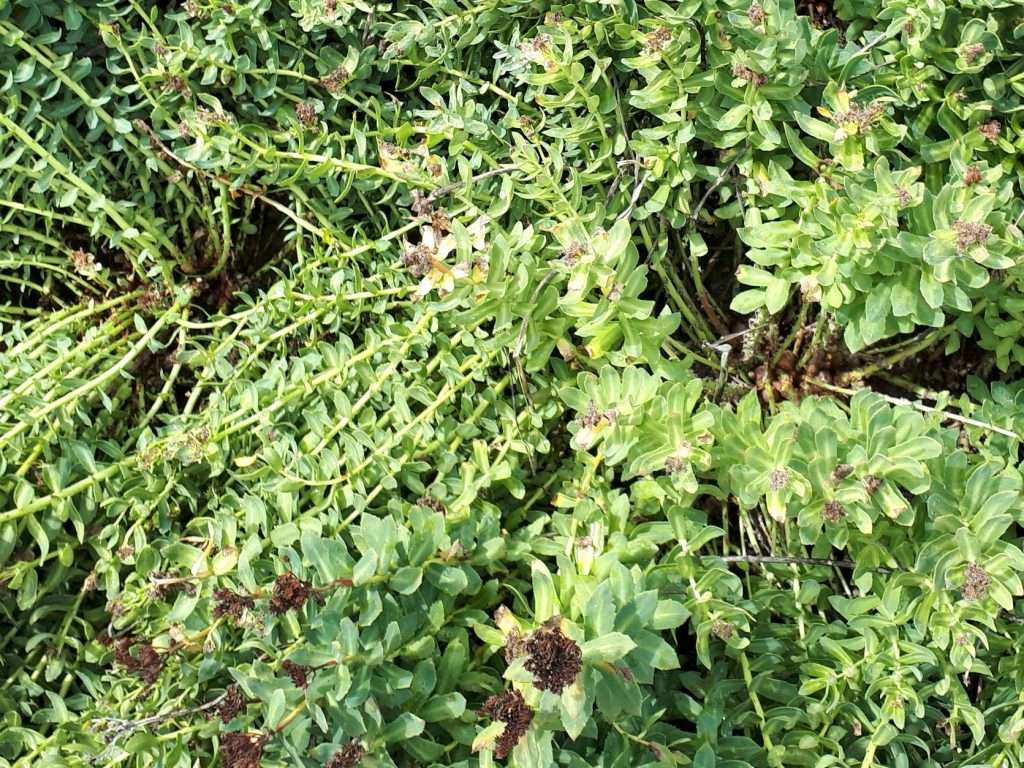
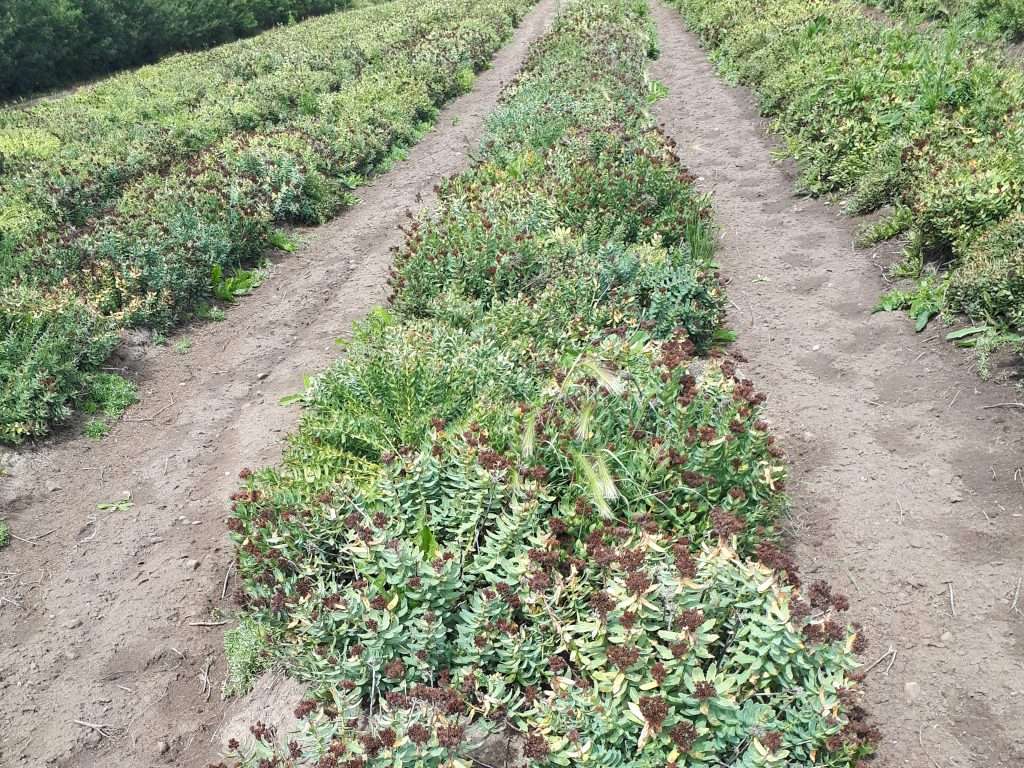
August, 2022 is coming to a close, and the weather in Alberta is dry and warm. The Rhodiola rosea completed its seasonal growth cycle about a month ago, and the stems are fading to yellows and browns. Since green is more becoming and appealing, the pictures in this article were taken in early August when the only visible brown came from the seed pods which adorned the female plants.
The pictures are from a conventionally-grown field on the Alberta prairies. Many hours of hard work get a field to this point of perfection. In the coming years, the fields may look less pristine, as we consider the cost of manual labor to control weeds. No herbicides have been approved for Rhodiola rosea in Canada, and the farmers continue to look for alternatives to grow healthy, high-yielding roots more efficiently and economically.
A closer look at the Rhodiola shows new buds forming at the crown or base of the plants. If conditions are right (a cool and rainy autumn) these buds may leaf out and the plant will enter a second growth cycle. Normally, though, a cool and dry fall will cause the buds to go dormant and the plant stores up energy in its crown and roots for the winter months.
Once the plants have gone dormant, it’s time to harvest. The roots will usually maintain their rosavin and salidroside levels during dormancy, and the farmer is ensured a good quality root. In Alberta the time for harvest can be measured in days, and with luck it will stretch out to two weeks or more. The farmers must harvest before the ground freezes and winter rolls in. The first icy blasts of winter literally freeze much of Alberta’s agricultural activity to a halt, and the harvest can be a sprint to that first hard frost.
Rhodiola Growers of Canada is working closely with the farmers to ensure the roots are harvested in prime condition. Timing is critical and good communication is essential. The plants look great this year and we look forward to an amazing harvest of sustainably-grown Rhodiola rosea.
If you have an interest is learning more about purchasing our sustainably-grown Rhodiola or about growing Rhodiola in any part of the world, please email Nelda Radford at nelda@rhodiolagrowers.ca.


When ordering the roots can there be a male and female in the same plant, or are they separate plants that behave differently. Also what are the uses of the greens and flower parts of the plants, and can they be used for medicinal purposes as well,ie: teas, or simply eating them for health reasons?
Thanks for your questions, Noella. The agronomists are mixed on the answer to your first question. Some say that a single plant can have both male and female flowers. Others are convinced that each plant can be either male or female, but not both. The botanical term is dioecious, meaning separate plants are either male or female. Rhodiola rosea is defined as being dioecious. You can identify the gender of the plant by its flowers. Please refer to the Knowledge Base for pictures of the male and female flowers.
It would be best to talk with an herbalist about the uses of the stems, leaves and flowers of Rhodiola rosea. We just like to grow it!